Email Us
News

News

Enjoy your outdoor life, enjoy durable outdoor products

Co-Extrusion Decking: The Next Generation of Durable Outdoor Flooring Technology

2026-07-28 0 Leave me a message

If you're choosing materials for an outdoor patio, garden walkway, or commercial landscape, you've likely weighed the pros and cons of traditional treated wood versus standard wood-plastic composites (WPC). In recent years, however, co-extrusion decking has rapidly gained market share—it looks and feels like wood, but offers significantly superior performance and longevity. This article breaks down the technology and hard data behind what makes this material a genuine step forward.

What Is Co-Extrusion Technology? A Protective "Armor" for Decking

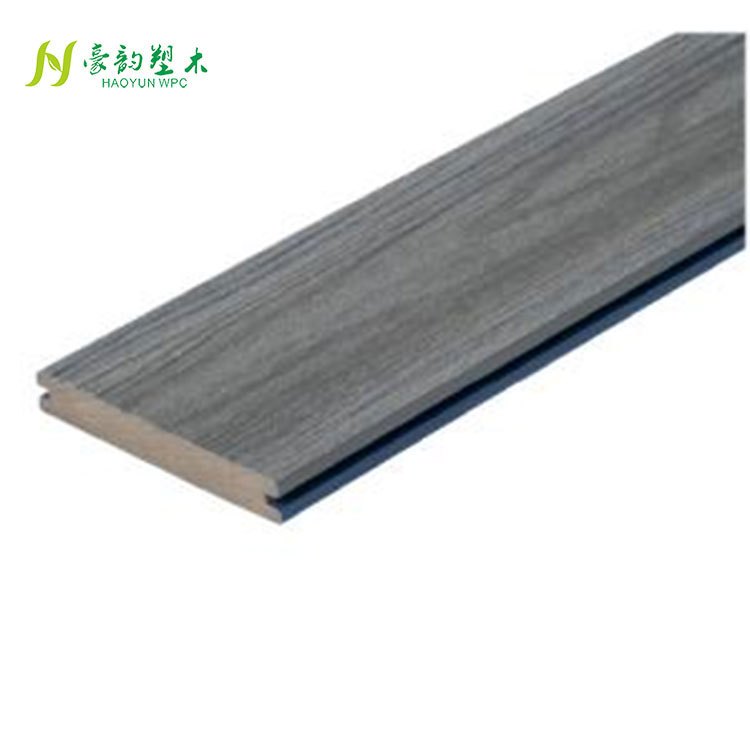
Traditional WPC decking is produced by extruding a homogeneous mixture of wood fiber and plastic (typically HDPE or PP). Co-extrusion decking, by contrast, uses a dual-layer co-extrusion process: simultaneously with the core layer extrusion, a dense functional cap layer is seamlessly wrapped around the entire surface (360°).

This cap layer is not applied as a post-forming coating. It is co-extruded and fused with the core under high heat in a single integrated process, ensuring zero delamination, peeling, or blistering over time. Think of it as a full-body protective shell—the core provides structural strength and rigidity, while the cap layer serves as a fortress against environmental aggressors.

The two most common cap layer materials are:

  • ASA (Acrylonitrile-Styrene-Acrylate copolymer): The industry benchmark, prized for superior weatherability, UV resistance, and color stability.

  • Modified engineering plastics (e.g., fluoropolymer-based compounds): Used in select premium products; can improve abrasion resistance by 30% or more compared to standard formulations.


Core Parameters and Performance Metrics

The advantages of co-extrusion decking are not anecdotal—they are measurable and verifiable.

1. Common Dimensions and Composition

Mainstream product profiles typically fall within the following ranges:

  • Width: 138–148 mm (5.4–5.8 inches)

  • Thickness: 21–23 mm (0.83–0.91 inches)

  • Length: Customizable to project needs (standard options: 2.2 m, 3.6 m, 5.8 m)

The 138 × 23 mm profile is one of the most widely used standard sizes.

A typical formulation comprises approximately:

  • 60% wood fiber

  • 30% HDPE (high-density polyethylene)

  • 10% functional additives (coupling agents, UV stabilizers, lubricants, etc.)

Bulk density generally falls in the range of 1.2–1.4 g/cm³—noticeably denser than natural timber, which contributes to a solid, substantial feel underfoot.

2. Mechanical Strength

The co-extruded structure delivers tangible strength improvements. In one documented technical implementation, the core was reinforced with specially treated glass fibers, raising the overall flexural strength to double that of conventional lumber. Independent load tests confirm this capacity: with joist spacing at 35 cm (≈14 inches), solid-core co-extrusion decking can sustain a concentrated load of 400–500 kg (≈880–1100 lbs) without permanent deformation.

Measured flexural strength: Approximately 40 MPa in third-party lab tests.
This level of structural integrity makes co-extrusion decking suitable for high-traffic commercial environments and public spaces.

3. Abrasion Resistance and Weathering Performance

This is where co-extrusion decking truly outshines its predecessors.

Scratch and abrasion resistance: Lab tests show that the cap layer improves abrasion resistance by more than 5 times compared to first-generation (un-capped) WPC products.
Water absorption: The cap layer exhibits extremely low hydrophilicity. In some patented systems, the 24-hour water absorption rate is controlled to below 0.5% (less than 5 parts per thousand).
UV/color stability: The most rigorous standard is the QUV accelerated weathering test. Premium co-extrusion decking maintains a Delta E (color difference) value of ≤ 4.0 after 3,000+ hours of QUV exposure. For context, a Delta E below 5 is generally imperceptible to the untrained eye—meaning the deck retains its original color tone even after years of direct sunlight.

4. Temperature Tolerance and Thermal Movement

Co-extrusion decking has an operational temperature range of approximately –40°C to +60°C (–40°F to 140°F), accommodating diverse climates from cold northern winters to hot tropical summers.

Thanks to the wood-fiber content, the coefficient of thermal expansion is significantly lower than that of unfilled plastics. This reduces seasonal gap variation and minimizes the risk of buckling or tenting—two common failure modes in pure polymer decking.


Installation and Maintenance: Pay Once, Relax for Decades

Installation method: Co-extrusion decking is generally installed with concealed fastening clips (hidden fasteners). This eliminates exposed screw heads on the surface, delivering a clean, splinter-free finish and faster installation than traditional nailing or screwing.

Maintenance requirements: This is the most practical differentiator. The dense, non-porous cap layer effectively blocks penetration by colored liquids, cooking oils, and organic stains. Routine cleaning requires only plain water or a mild detergent—no annual sanding, sealing, staining, or anti-rot treatment is ever needed.

  • Typical warranty period: 20–25 years (transferable in many cases), reflecting manufacturer confidence in long-term durability.


Critical Buyer Warnings

Not all "co-extruded" decking is created equal. Watch for these pitfalls:

  1. Beware of pseudo-co-extrusion: Some products are merely surface-coated or spray-lacquered with a thin protective layer, rather than being true co-extruded. These "lookalike" coatings can peel, flake, or delaminate within 1–2 seasons. Insist on cross-sectional inspection: a genuine co-extrusion product displays a clean, uniform line between the cap and core, with no gaps or visible separation.

  2. Don't compare price tags in isolation: The upfront cost of co-extrusion decking is higher than treated lumber. However, factoring in $0 in maintenance costs over 20 years versus the recurring expense of sealing, staining, and replacing rotted wood, the total life-cycle cost is actually lower. The break-even point typically occurs within 5–7 years of installation.

  3. Strict joist spacing compliance: Always follow the manufacturer's specified joist spacing—≤ 35 cm (≤ 14 inches) center-to-center is the universal recommendation. Exceeding this spacing will compromise load-bearing capacity and may void the warranty. Heavier commercial applications may require even tighter spacing (e.g., 30 cm).


Co-extrusion decking successfully resolves the three persistent shortcomings of standard WPC: low scratch resistance, poor color retention, and high moisture uptake. By combining a wood-fiber-reinforced core with a high-performance polymeric cap layer, it delivers a deck that looks premium, performs reliably, and requires almost zero maintenance over its service life. If your goal is to install an outdoor floor once and forget about it for the next 20 years, this material deserves a serious look—and the data backs it up.

Related News
Leave me a message
E-mail
hy@zjhaoyun.com
Mobile
+83-13757270793
Address
South of Hongqi Rd. East of Shuquan Street, Xiaoyuan Street, Anji, Huzhou, Zhejiang, China.
X
We use cookies to offer you a better browsing experience, analyze site traffic and personalize content. By using this site, you agree to our use of cookies.Privacy Policy
RejectAccept